
Delivering data-driven insights for strategic financial decisions
*Free & Easy - no hidden fees.
 Call For Demo 9168696091/92/93
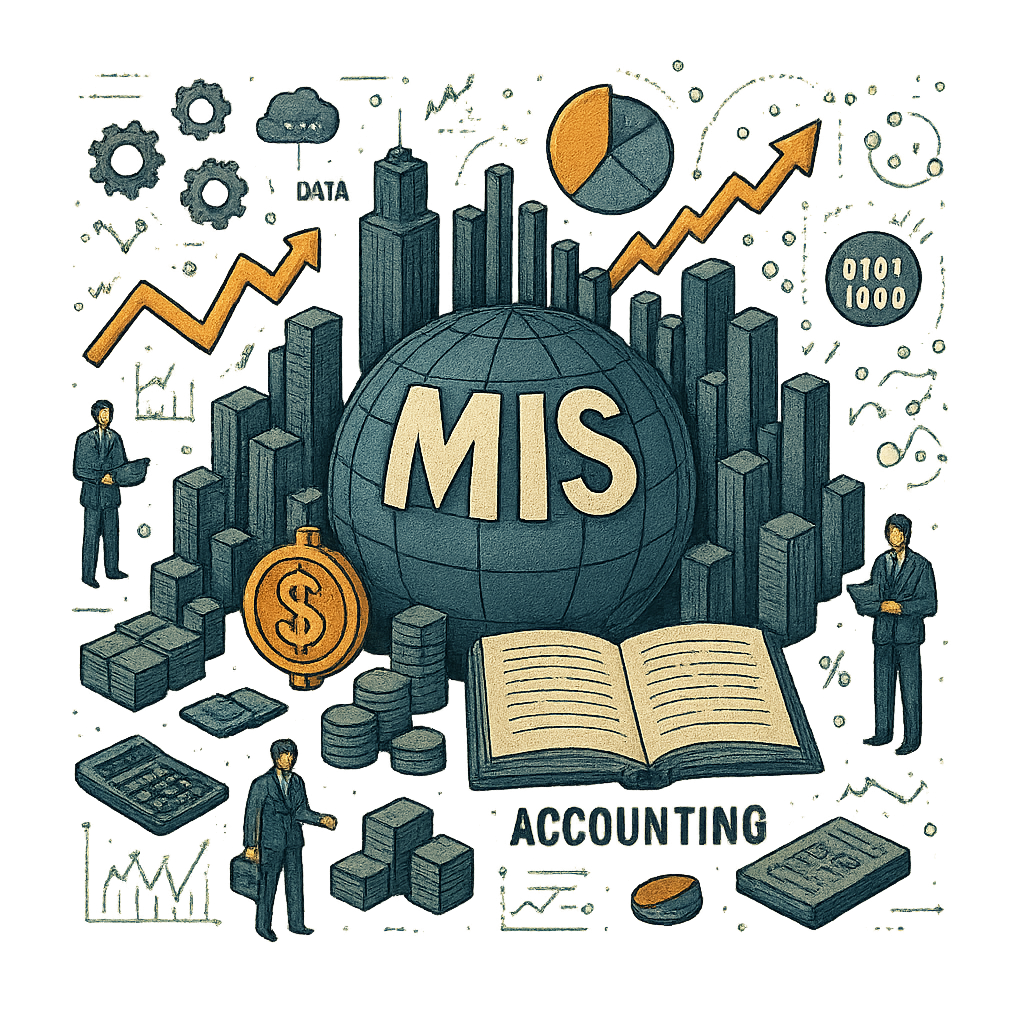







With the current dynamic, fast-paced business world, merely recording transactions will no longer do. Organizations require real-time information regarding their financial status so that they can make decisions, forecast future trends, and remain competitive. MIS accounting speaks to this demand. Through converting raw financial data into insightful reports, MIS equips management to handle complexities confidently and with clarity.
Management Information System (MIS) accounting is a systematic system that collects, processes, and reports the financial data to support strategic decision-making within an organization. Whereas classical accounting mechanisms are primarily transactionally oriented in their nature, MIS involves reporting, forecasting, budgeting, and data analysis and hence is used as an important management instrument.
Some of the primary functions of MIS in accounting are:
Data Collection: Compiling financial and operational information.
Processing and Analysis: Includes summarizing and analyzing financial data to generate helpful conclusions.
Reporting: Making reports to enable planning, observing, and controlling work.
An effective MIS transforms accounting data into actionable intelligence for business growth.
A well-implemented MIS offers different types of reports tailored to meet varied management needs:
Income Statements: Report profit or loss generated during a period of time.
Balance Sheets: Provide a snapshot of shareholders' assets, liabilities, and equity at a point in time.
Cash Flow Statements: Are cash inflow and outflow statements, which are required for liquidity management.
Budget vs. Actual: Analyze variances between projected and actual financial performance.
Stock Levels and Turnover Rates: Monitor inventory usage, reorder points, and optimize stock management.
Revenue Trends and Customer Analytics: Evaluate product performance, sales growth, and customer behavior.
Anomaly Detection: Identify departures from anticipated financial measures, signaling early potential problems.
Every type of report facilitates more anticipatory management by concentrating on performance measures most important to organizational success.

Adopting MIS in accounting offers multiple advantages:
Access to real-time accurate information enables managers to take well-informed strategic choices with less uncertainty and unnecessary risk.
Management Information Systems (MIS) streamline data gathering and automate reporting processes, minimizing manual mistakes and saving valuable time.
An effective MIS helps companies comply with financial reporting standards such as GAAP and IFRS, reducing the risk of non-compliance.
Study of historical trends, MIS makes budgeting, forecasting, and long-term strategic planning easier.
MIS improves internal checks and balances by offering current financial transparency, allowing quicker corrective actions.
Effective MIS reporting closes the gap between financial accounting and strategic decision-making, ensuring better organizational alignment.
Developing a reliable MIS calls for thorough planning and exact execution:
Choose an accounting solution with strong MIS capabilities (e.g., QuickBooks, SAP, Oracle Financials).
Establish uniform data entry guidelines to maintain consistency among all departments.
Offer detailed training to ensure effective use of the MIS tools.
Integrate MIS with current ERP, CRM, and inventory systems to ensure smooth data transfer.
Regularly review MIS outputs and refine reporting templates to align with evolving business needs.
A phased and systematic approach is key to successful MIS implementation.
A large retail chain uses MIS reports to monitor daily sales, inventory turnover, and customer buying patterns, enabling data-driven restocking decisions and targeted promotions.
An example of a manufacturing company utilizes MIS to monitor manufacturing expenditures, study work productivity, and project the needs for materials, all which assist them in simplifying their budgeting and resources planning.

MIS accounting has become an essential management tool of contemporary organizations. By facilitating effective reporting, strategic planning, and improved operational efficiency, MIS increases organizational ability to respond effectively in a changing market place. Companies, small or big, which are dedicated to strong MIS solutions have a better likelihood of achieving financial flexibility, compliance, and sustainable growth. With data-based living on the rise today, MIS stands for success management, not information management anymore.
 GST Export Invoice Format
Requirements for export invoice templates in GST.
 Credit Note Format
Why Need Credit Note?

Requirements for composition scheme documents.

GST features in online billing software.

Requirements for export invoice templates in GST.

Receipt of items or services for GST Exempt.

केंद्रीय वस्तु एवं सेवा कर

Receipt voucher record the receipt of payment.




MIS collects, analyzes and reports financial data to assist management in planning, decision making, and performance tracking in accounting.
Traditional accounting is all recording of transactions, but MIS is concerned with analysis of financial data to aid managerial decision making.
Indeed! Small companies can utilize MIS for efficiency, forecasting,cash management, and budgeting.
Challenges include the high cost of software, employee training needs, and ensuring data security and accuracy.
Yes, several software options integrate MIS with accounting, including SAP, Oracle Financials, and many cloud-based solutions tailored for SMEs.
 Free training & support
 60K Happy Customers Worldwide
 Serious about Security & Privacy
Streamline Your Accounting with Smart MIS SolutionsStart your free demo today and transform how you manage financial data!
*Free & Easy - no hidden fees.
 Call Back Request