






Goods returned
The customer returns goods and you accept a reduction against the sale.

GST CREDIT NOTE GUIDE
Make invoice adjustments easier to understand. Explore an annotated credit note, checked sample downloads and the steps to create one with Sleek Bill Online.
Call For Demo: 9168696091 / 92 / 93 | Get Android app ↗
FORMAT · EXAMPLE · ONLINE WORKFLOW
A credit note records a supplier’s reduction to an earlier invoice, such as an accepted goods return or an overcharge. It documents the adjustment; it does not automatically refund money or make a GST tax reduction eligible.
Guidance reviewed: 19 October 2026 · Official sources linked below
The customer returns goods and you accept a reduction against the sale.
You agree to reduce the charge because the supply was defective or incomplete.
The invoice charged more than the quantity supplied or the agreed value.
The invoice overstated tax and the correction requires a credit note.
Keep the original invoice, return or service evidence, and the reason for the adjustment together. A customer’s excess payment is a payment balance, not by itself a reason to reduce the taxable value of a correct invoice.
Rule 53(1A) sets out the particulars. Use the checklist below when preparing or reviewing a note.
Item descriptions, quantities and a clear reason make reconciliation easier. Official Rule 53 particulars ↗
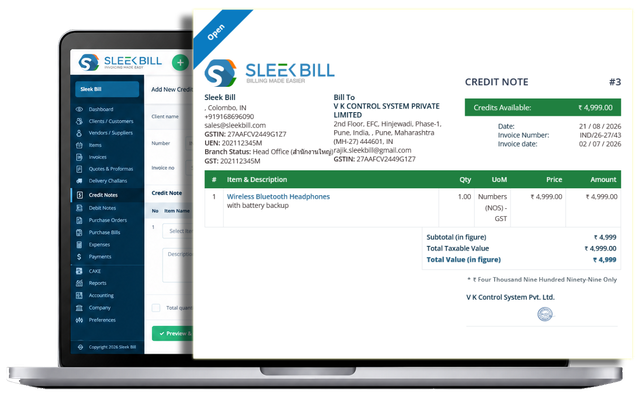
This Sleek Bill credit note sample illustrates how supplier and customer details, invoice references, item values, GST, totals and signature information appear on a credit note. Click or refer to the numbered markers to understand each section.
 1
2
3
4
5
6
Note: This image is an illustrative billing-software example, not a universal GST invoice template. The applicable particulars and tax treatment depend on the transaction and current GST requirements.
The existing files were checked on 19 October 2026. All three working links below return the expected file type. They contain a January 2025 product sample; sample rates and business details should not be reused as current tax advice.
Image-based PDF · 2 pages (second mostly blank) · about 696 KB. Useful for seeing the document; not a fillable form.
Open PDF sample ↗DOCX · about 1 MB. Much of the content is embedded as images; editing is limited.
Download Word sampleXLSX · about 736 KB. A layout sample with converted content, not a formula-driven calculator.
Download Excel sampleThese files are samples rather than blank templates. To create a fresh document, enter your own customer, invoice, items and taxes in Sleek Bill Online, then review the preview.
GST REPORTING AND TAX ADJUSTMENT
Under Section 34(2), report a credit note in the return for the month of issue, no later than 30 November following the supply’s financial year or the date the relevant annual return is furnished, whichever is earlier.
Example: for a supply in FY 2025–26, the normal outer date is 30 November 2026; an earlier annual-return filing brings the cut-off forward. This concerns GST reporting and tax adjustment, not a blanket deadline for every commercial credit.
The current Section 34 proviso, effective from 1 October 2025, bars supplier tax reduction if a registered recipient has not reversed attributable ITC already availed. In other cases, reduction is barred where the tax incidence has been passed to another person.
A saved credit note alone does not establish eligibility. Review the return entries and supporting records. Read current Section 34 and its commencement notes ↗
A financial or commercial credit can adjust the amount owed without reducing GST. For example, a post-sale discount that does not meet the applicable GST valuation conditions should not automatically reduce taxable value or output tax. CBIC Circular 92/11/2019-GST ↗
The CBIC compilation includes amendments with separate commencement notes. An enacted change marked “yet to be notified” should not be treated as already operative. Check the effective provision for your transaction with your accountant.
Follow these steps to create, save, download, or print a credit note in Sleek Bill Online. Before saving, verify the original invoice, reason for issuing the credit note, item quantities, and applicable GST amounts.
Open your web browser and visit Sleek Bill . Click the LOGIN button at the top-right corner of the homepage to access your account.

Enter your registered email address and password, then click the green Sign in button. You can also sign in using Google if that option is available for your account.

After logging in, locate the left sidebar menu on your dashboard and select Credit Notes. On the Credit Notes management screen, click the green + New button to create a credit note.

Fill out the creation form by selecting the client name, linking the original invoice number and date, and choosing the reason for issuing the credit note. Next, add the specific items or services being adjusted along with their quantities, unit prices, and applicable GST tax rates.

Review the customer details, original invoice reference, reason, item quantities, subtotal, and tax amounts. Once everything is correct, click the green Preview & save button to save the credit note.

Check the saved credit note preview before sharing it with your customer. Select PDF to download a copy or Print to generate a paper copy, depending on the options available on your screen.

Tip: A credit note can reduce the amount payable against an earlier invoice. If you want to use available customer credit against a new invoice, check whether the Use credit option is available for that customer. Record any actual cash refund separately.
| Document or Action | What It Does | Typical Situation |
|---|---|---|
| Credit Note | Records a reduction in a previously charged amount. | Accepted sales return, overcharge, or eligible price adjustment. |
| Refund | Returns money to the customer. | Paying back an amount by bank transfer or another payment method. |
| GST Debit Note | Records an increase in the taxable value or tax charged on an earlier supply, subject to applicable GST rules. | The original invoice charged less than the correct taxable value or tax. |
A buyer's internal purchase-return debit memo is different from a supplier-issued GST debit note. The correct document and GST treatment depend on the transaction and applicable tax rules.
 GST Invoice Format
Requirements for invoice templates in GST.
 GST Billing Benefits
Advantages & benefits of the new tax system.
 GST Bill of Supply
Requirements for composition scheme documents.
 GST Billing Software
GST features in online billing software.
 GST Online Advantages
Benefits of online over offline invoice software.
 GST Credit Note
Find out when and how to issue GST compliant credit notes.

Requirements for export invoice templates in GST.
Receipt of items or services for GST Exempt.
केंद्रीय वस्तु एवं सेवा कर

Receipt voucher record the receipt of payment.


Simplify GST credit note management and save time with Sleek Bill. Create credit notes easily with
GST billing software that grows with your business.
*Free & Easy - no hidden fees.
See how Sleek Bill helps businesses simplify billing and manage everyday operations.

I've been using Sleek Bill for 4 months now and I love it. It is very user-friendly and easy to set up. It's a complete software where you can easily create invoices, quotations, etc. The customer support was very good and helpful. The value of this program is one of the best around.
 Balram Singh
JSA Engineering
Surprisingly, it's very easy to use. This is a user-friendly software for any type of business. After using Sleek Bill, our work is going very smoothly. We are very satisfied with this product!
 Mohd. Rahbar Ahmad
Cute Handicrafts
Sleek Bill is very user-friendly. It saves time, and data can easily be viewed whenever needed. The PDF conversion of invoices feature is good. Overall, the software is very good for any small business. I would recommend this to others!
 Jitendra Kumar
JP India
No. A credit note records an adjustment; a refund returns money. A credit balance may be applied to an invoice or settled by a separate refund, depending on the agreement and recorded transactions.
The supplier issues the GST debit note for an undercharge. A buyer’s purchase-return memo is a different accounting document; see the comparison above.
No. Review the distinction between commercial credit and GST adjustment, and the tax-reduction conditions above before changing return figures.
Sleek Bill Online’s customer-credit guide shows selecting Use credit on an invoice for the same customer, choosing available entries and selecting Apply. Check the resulting balance.
A commercial settlement is distinct from a GST reduction. Missing the GST reporting cut-off does not create a right to reduce output tax; obtain advice on recording the settlement.
They are converted samples with image-based or converted content. They are not clean blank forms or verified tax calculators. Create a fresh Online document for your own transaction.
Do not treat deletion in software as a return correction. Preserve the document history and review the appropriate amendment process with your accountant.
Open the saved credit-note preview and use PDF. Print is also shown in the current published preview. Review the customer, invoice reference, amounts and taxes first.
 Free training & support
 3M+ Happy Businesses
 Serious about Security & Privacy
*Free & Easy - no hidden fees.