A Complete Guide Understanding GST Returns
*Free & Easy - no hidden fees.
 Call For Demo 9168696091/92/93







The term GST return can refer to some form or return that taxpayers have to file for each GSTIN registered under the Goods and Services Tax Act. The return contains sales, purchases, tax collected and input tax credit claimed. The returns filed accordingly in time avoid penalties.
The GST system prescribes 22 types of returns under GST, categorized into active, suspended, and view-only returns:
11 Active Returns (filed by different taxpayer categories)
4 Suspended Returns (previously required but now discontinued)
8 View-Only Returns (auto-generated and used for reconciliation)
These returns apply to Types of Returns Under GST, including regular taxpayers, composition scheme taxpayers, e-commerce operators, TDS diductor’s, Input Service Distributors (ISD), and non-resident taxpayers.
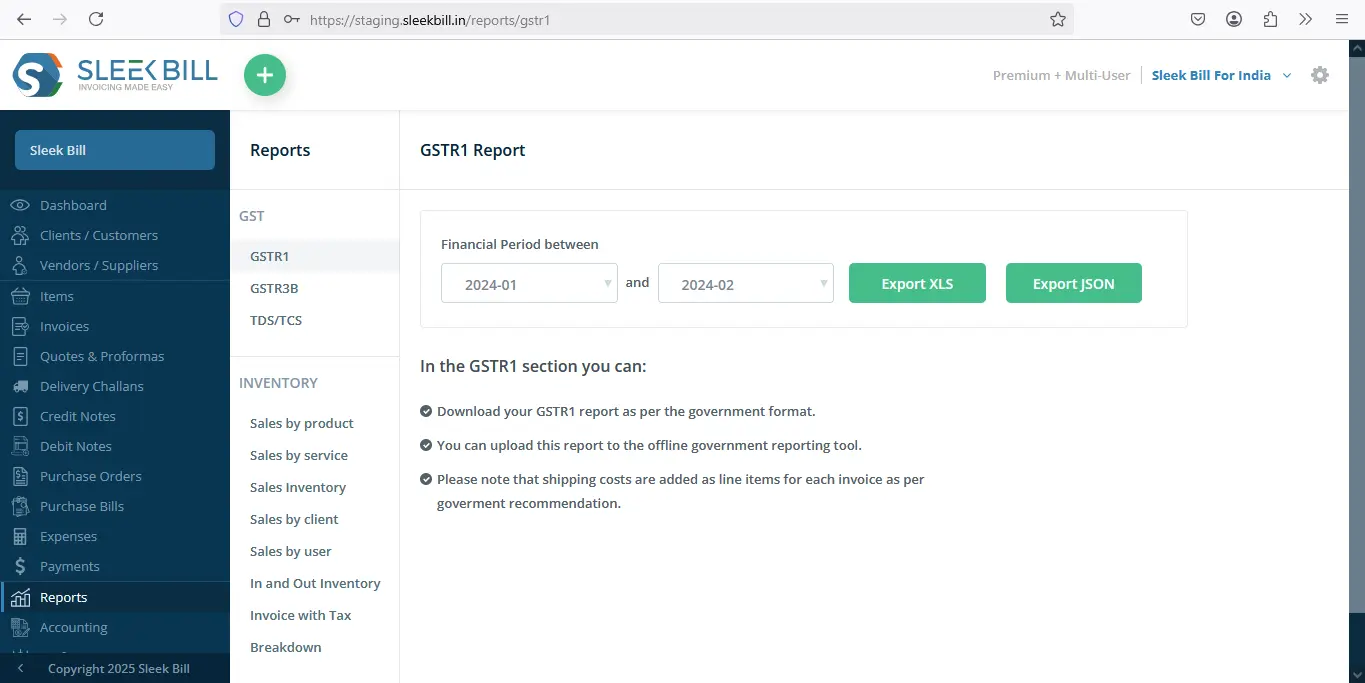
Login in Sleek Bill
Click on reports section
Then below the Financial Period between select the dates for duration of GSTR1 reports.
Click on Export button
Login in Sleek Bill
Click on reports section
Click on GSTR-3B
Then below the Financial Period between select the dates for duration of GSTR1 reports.
Click on Export button
Filed by: Regular taxpayers (including casual taxable persons)
Purpose: Reports details of invoices and debit-credit notes on sales transactions.
Filing Frequency:
Monthly (if turnover > Rs. 5 crore): 11th of every month
Quarterly (QRMP scheme): 13th of the following month
Filed by: View-only for buyers (used for ITC claim)
Purpose: Auto-populated details of inward supplies based on GSTR-1 filed by suppliers.
Status: Used until August 2020, still referred to for ITC reconciliation.
Filed by: View-only for buyers
Purpose: Provides constant ITC data for each period with action items for reconciliation.
Available from: August 2020
Filed by: Regular taxpayers
Purpose: Summary of outward supplies, ITC claimed, tax liability, and payments.
Filing Frequency:
● Monthly (turnover > Rs. 5 crore): 20th of next month
● Quarterly (QRMP scheme):
● 22nd (Category X states like Maharashtra, Gujarat) ● 24th (Category Y states like Uttar Pradesh, Bihar)
Filed by: Composition taxpayers
Purpose: Replaced GSTR-9A for Annual Report from FY 2019-20.
Filing Due Date: Annually, by 30th April
Filed by: Non-resident foreign taxpayers
Purpose:Reports outward and inward supplies, tax liability, and payments.
Filing Due Date: 20th of each month
Filed by: Online Information and Database Access or Retrieval Services (OIDAR) providers.
Purpose:Summary return for reporting outward supplies and tax payable.
Filing Due Date: 20th of each month
Filed by: Input Service Distributors
Purpose: Reports ITC received and distributed among branches.
Filing Due Date: 13th of each month
Filed by: Persons required to deduct TDS under GST
Purpose: Reports TDS deducted, liability, and refunds claimed.
Filing Due Date: 10th of each month
Filed by: E-commerce operators collecting Tax Collected at Source (TCS)
Purpose: Reports details of supplies made through their platform and TCS collected.
Filing Due Date: 10th of each month
Filed by: Regular taxpayers (optional for turnover < Rs. 2 crore for FY 2017-20)
Purpose: To collect all monthly and quarterly returns filed during the financial year.
Last date of filing: 31st December of next financial year
Filed by: Taxpayers with turnover > Rs. 5 crore
Purpose: Self-certified reconciliation between books of accounts and GST returns.
Filing Due Date: 31st December (same as GSTR-9)
Filed by: Taxpayers whose GST registration has been cancelled.
Purpose: Reports pending tax liabilities.
Filing Due Date: Within three months from cancellation
Filed by: Foreign embassies, UN bodies, etc. (with Unique Identity Number - UIN)
Purpose:Claims refund of GST paid on purchases in India.
Filing Due Date: 28th of the month following the quarter.
| Return Type | Late Fee (Per Day) | Maximum Late Fee |
|---|---|---|
| GSTR-1, 3B, 4 | Rs. 100 (CGST) + Rs. 100 (SGST) | Rs. 5,000 per Act |
| GSTR-9/9C | 0.25% of turnover per Act | No limit |
| Interest on Late Tax Payment | 18% per annum | Based on outstanding tax |
Late filing of GST returns results in cascading penalties and loss of Input Tax Credit (ITC).
The late fee for GSTR-1 is auto-populated in the liability ledger of the next GSTR-3B.

GST return filing in time would prevent penalties and ensure completion, while having appropriate tax records. Considering the various categories of taxpayers for whom return types exist, the due dates and requirements for returns shall be understood.
Automated GST return filing solutions will make the process much easier and minimize errors. With hassle-free GST return filing and compliance at its core, explore Sleek Bill's GST solutions and get accurate and timely tax filings.
 GST Export Invoice Format
Requirements for export invoice templates in GST.
 Credit Note Format
Why Need Credit Note?

Requirements for composition scheme documents.

GST features in online billing software.

Requirements for export invoice templates in GST.

Receipt of items or services for GST Exempt.

केंद्रीय वस्तु एवं सेवा कर

Receipt voucher record the receipt of payment.




It is GSTR-4 of the composition dealer, that being quarterly or annually filed and reflecting sales, purchase, and other taxes paid for the relevant accounting period. Here, in India, these businessmen pay fixed per cent and thereby have a simpler compliance system
GST returns forms are the formal reports that any business needs to submit to the government, relating to their sales, purchases, tax collected and paid. Government can track payment of GST amount through these forms and check upon the compliance.
GSTR-1 – monthly or quarterly return wherein businesses make sales and outward supplies report.
GSTR-2A: Read-only auto-drafted report reflecting purchase details as furnished by the suppliers in GSTR-1.
GSTR-2B: A static ITC statement to help the businesses understand the ITC amount that can be claimed.
GSTR-3B: A summary return that would include declaring total sales, total purchases, total tax liability, and ITC to be claimed before making payment of tax.
 Free training & support
 60K Happy Customers Worldwide
 Serious about Security & Privacy
Stay compliant and avoid penalties—Understand GSTR-1, GSTR-3B today!
*Free & Easy - no hidden fees.
 Call Back Request