
A Professional Guide to Accurate Transaction Records
*Free & Easy - no hidden fees.
 Call For Demo 9168696091/92/93








Every successful transaction is followed by a receipt. Whether you are a small business owner, a freelancer, or a firm, giving an accurate and precise payment receipt template is necessary for the purpose of ensuring transparency, tracking revenues, and ensuring tax compliance. It serves as a physical evidence of payment provided, assuring both buyer and seller security. In this blog, we’ll explore what a receipt format entails, its importance in accounting, the difference between capital and revenue receipts, and why using a digital, professionally designed template can help your business grow faster, manage inventory, and improve financial workflows easily.
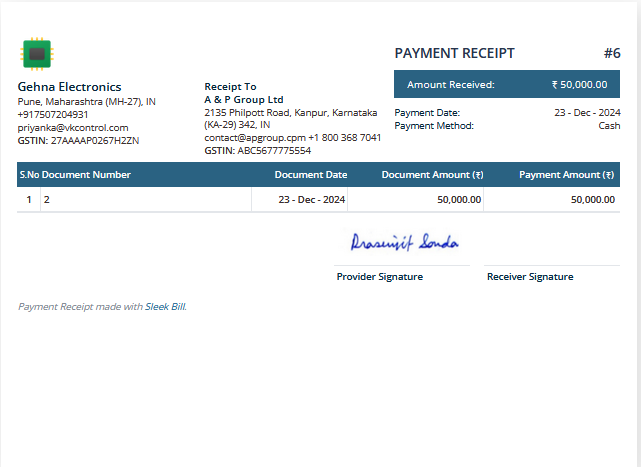
A receipt format refers to an organized structure applied in recording the satisfaction of a payment transaction. A receipt is a legal instrument expressing that money was received by the seller from the buyer as compensation for services or goods. Key elements of a payment receipt format include:
Seller and buyer information
Transaction date
Item description and quantity
Amount paid
Sales taxes (if applicable)
Payment method (cash, card, UPI, etc.)
Receipts are vital for maintaining transaction records, especially for accounting, tax filing, audits, and inventory management.
It is important to understand receipts from an accounting point of view to ensure proper financial reporting. Receipts fall into two broad categories:
They are revenues from normal business activities and are posted in the income statement.
Examples: sales revenue, interest income, discounts received
Impact: Shown as income in the profit & loss statement
Related to: liabilities, expenses, assets, and tax implications within the financial year
These are non-recurring receipts not part of daily operations and usually involve asset or liability accounts.
Examples: sale of fixed assets, capital contributions, loans from financial institutions
Impact: Appears on the balance sheet but does not show up on the income statement.
Related to: funding, investments, or stakeholder equity
Revenue receipts = routine and operational
Capital receipts = sporadic, frequently long-term and investment-driven

Issuing receipts isn’t just good practice—it’s a legal and operational safeguard.
Proof of Transfer – Verifies that the seller has received the payment.
Documentation – Supports account entries and tracks income.
Safeguard for Returns or Disputes –Used in insurance claims, product warranties, or service guarantees.
Tax and Audit Compliance – Essential for keeping finances transparent and handling audit questions effectively.
| Aspect | Invoice | Receipt |
|---|---|---|
| Issuance Time | Before payment | After payment |
| Purpose | Asking for payment | Confirming it has been received |
| Legal Value | Request for transaction | Proof of completed transaction |
| Includes | Full amount owed with payment date | Paid amount along with the payment date. |
| Used for | Tracking receivables | Tracking received payments |
As the advantages of digital receipts continue to increase, old-fashioned paper ones are rapidly becoming obsolete Here’s why businesses are shifting online:
Go Paperless – Eliminate clutter and save on printing equipment and paper costs
Easy Storage & Retrieval – Store receipts in the cloud, accessible anytime for tax or audit purposes
Save Money –Reduce operational expenses and manual labor
Faster Communication –Send receipts by email or WhatsApp as soon as the payment is completed
Accuracy of Records- Ensures every transaction is accounted for
Reduces manual errors and mismatches in accounting
Supports Tax Deductions- Clear receipts are necessary to claim expenses, file taxes, and reduce tax liabilities
Reduces Audit Risk-Professional and official receipts lower the likelihood of audit red flags
To design a clear and professional receipt, be sure to include the following details.
Title – "Payment Receipt" or "Official Receipt"
Seller Information – Name, address, GSTIN (if applicable)
Buyer Information – Name, address, email
Receipt Number – Unique identifier
Date of Payment
Description of Goods/Services
Amount Paid – With breakdown of taxes (CGST, SGST, IGST)
Payment Method – Cash, card, UPI, cheque, etc.
Authorized Signature
Terms & Notes – Return policy, thank-you note, or reference ID

A payment receipt template is not merely a paper—it's a device that maintains financial integrity, boosts professionalism, and fosters trust between you and your customers. For routine retail transactions or high-value B2B payments, having a properly formatted receipt template is vital to maintain your operations transparent, organized, and audit-ready.
 GST Export Invoice Format
Requirements for export invoice templates in GST.
 Credit Note Format
Why Need Credit Note?

Requirements for composition scheme documents.

GST features in online billing software.

Requirements for export invoice templates in GST.
Receipt of items or services for GST Exempt.
केंद्रीय वस्तु एवं सेवा कर

Receipt voucher record the receipt of payment.




It is the systematic format employed in recording payments, which may incorporate information like payer, payee, amount, date, and mode of payment.
A customer receipt provides proof of payment after a transaction, confirming the seller has received the money.
Start with a clear title, include buyer and seller details, transaction date, list of items or services, amount paid, tax details (if any), and the payment method. Sign and date the receipt for authenticity.
 Free training & support
 60K Happy Customers Worldwide
 Serious about Security & Privacy
to simplify your billing process, manage inventory better, and grow your business with confidence.
*Free & Easy - no hidden fees.
 Call Back Request