
Complete Guide about Suspense Account
*Free & Easy - no hidden fees.
 Call For Demo 9168696091/92/93




In accounting, accurate records aren't a best practice but they're a necessity for financial transparency and credibility. But occasionally, transactions develop with missing or ambiguous information. When that occurs, accountants have a very handy tool at their disposal: the suspense account.
Let us know what a suspense account is, how it is used in accounting, and how companies can control it efficiently.
Suspense account is an account in the general ledger to hold on to uncertain or unclassified transactions briefly until they may be identified or allocated correctly.
As per UC Davis Finance and Business, a suspense account makes sure that all the financial transactions are posted in a timely manner, even when not immediate classification.
Effectively, it is a holding place for transactions so that they will not be missed, thus maintaining the integrity of financial reports.
Suspense accounts have various significant functions:
Timely Recording: Allow transactions to be posted in real time as they happen, even before information is settled.
Error Management: Help to isolate for further investigation, discrepancies, i.e., trial balance errors.
Financial Integrity: Ensure that all transactions are captured before financial reporting to ensure completeness.
Operational Continuity: Enable everyday functions to continue uninterrupted by financial processing delays.
Without suspense accounts, unrecorded transactions or uncompleted ones can cause reporting inaccuracies, as well as decision-making loopholes.
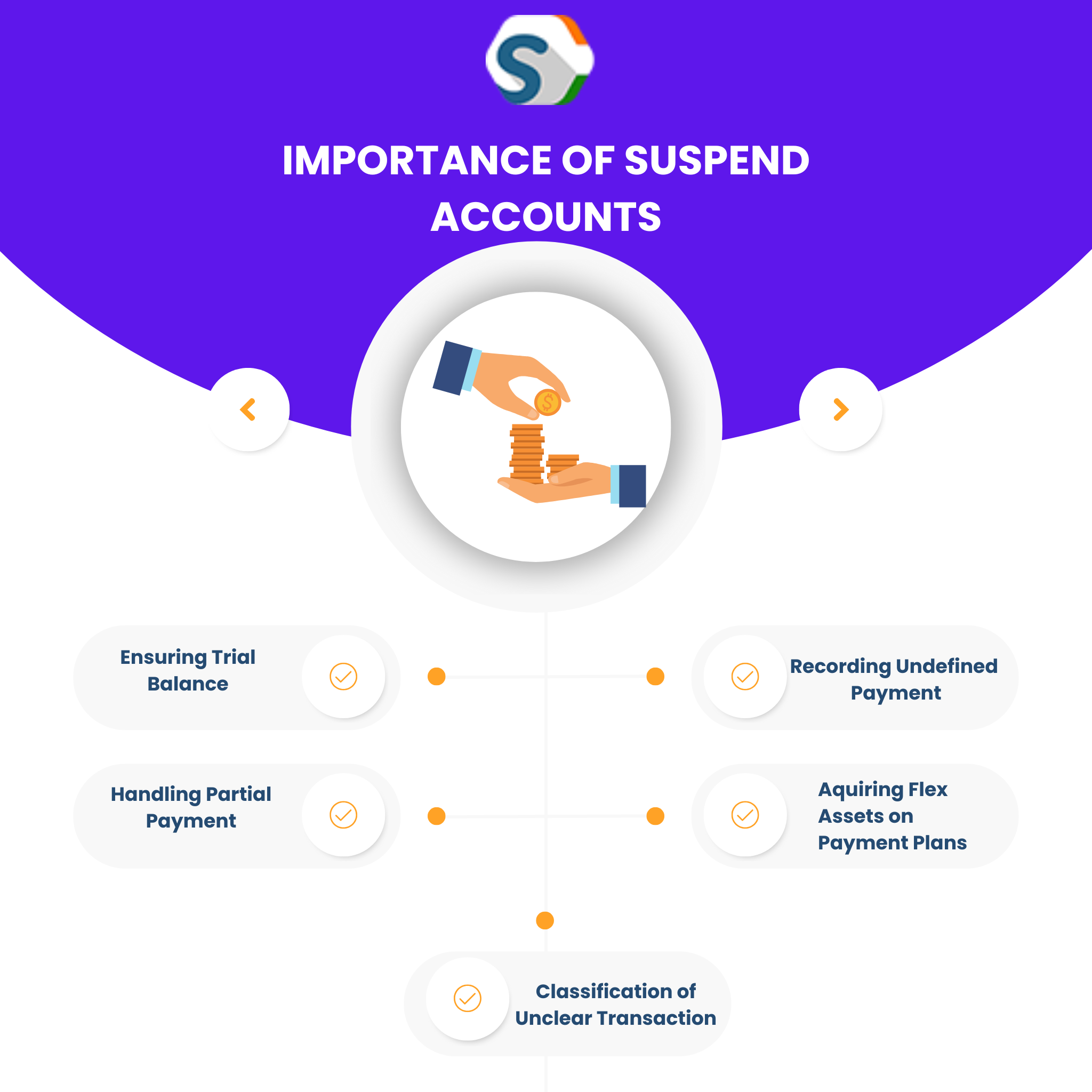
The following are typical situations where a suspense account may be used:
1. Unidentified Payments:
When payment is received without related invoice or customer information.
2. Partial Payments:
When a customer pays an amount which is not the full amount of any outstanding invoice.
3. Errors in Trial Balance:
When debits and credits don't match in total, and the difference is carried temporarily.
4. Unclassified Transactions:
When the proper account classification is unknown when it is being posted.

Initial Entry:
Debit: Bank Account ₹5,000
Credit: Suspense Account ₹5,000
Following Identification:
Debit: Suspense Account ₹5,000
Credit: Accounts Receivable ₹5,000
Temporary Entry:
Debit: Suspense Account ₹2,000
After the error is detected and rectified, this account is reversed and suspense account cleared.
Verify every entry to get any incomplete or additional information.
Determine the correct general ledger accounts for each.
Reallocate the entries from the suspense account to the correct accounts.
Ensure the suspense account balance returns to zero after reconciliation for the proper financial records management.
Timely completion of all the above steps for suspense account is required to ensure correct financial reports and audit readiness.

To handle suspense accounts properly and minimize mistakes for correct financial management:
Regular review of transactions:
Conduct regular reviews to eliminate outstanding or misclassified transactions in financial records.
Document Thoroughly about reason for entry in suspense account:
Maintain very accurate records of the reason an entry was put on suspense and how it was removed from the suspense account.
Implement Internal Controls:
Implement procedures for dealing with suspicious or ambiguous transactions. This procedures will help to manage financial records properly.
Train Staff about the use of suspense account:
Educate accounting personnel on proper use and clearance of suspense accounts for management of transactions.
An effectively maintained suspense account system reduces the risk of financial misstatements and enhances organizational credibility.

Suspense account is a convenient accounting tool to handle incomplete or uncertain transactions. Although it is convenient for ready recording, it must be handled carefully and be cleared promptly so that the reliability and accuracy of financial reports can be ensured. A well-controlled suspense account system reflects sound financial management and engenders stakeholder trust.
 GST Export Invoice Format
Requirements for export invoice templates in GST.
 Credit Note Format
Why Need Credit Note?

Requirements for composition scheme documents.

GST features in online billing software.

Requirements for export invoice templates in GST.

Receipt of items or services for GST Exempt.

केंद्रीय वस्तु एवं सेवा कर

Receipt voucher record the receipt of payment.


Suspense account holds for uncertain or doubtful transactions.
A clearing account briefly holds known transactions pending final assignment.
Yes. The balance can be credit or debit, based on the character of transactions posted.
No. Suspense accounts should be paid as early as possible with proper details so that they can be reported accurately.
It appears on the balance sheet as current asset or current liability, whichever is the case.
 Free training & support
 60K Happy Customers Worldwide
 Serious about Security & Privacy
For financial accuracy,transparency and credibility Suspense Account are Important
*Free & Easy - no hidden fees.
 Call Back Request