A Complete Guide for Import-Export Business
*Free & Easy - no hidden fees.
 Call For Demo 9168696091/92/93


In the global connected economy, import and export businesses play a important role in linking markets, meeting the demands of consumers, and driving towards economic growth. But what is an import and export business? How do they function, and is it profitable? In this comprehensive guide, we will learn the concepts of import and export companies, how to begin one, types engaged, most critical differences, and how to succeed.
An import business has a specialty for purchasing goods from international suppliers and reselling domestically. Import businesses satisfy consumers through providing foreign items and making them affordable.
How Do Import Businesses Operate?
Operating an import business involves:
Supplier Identification: Finding good foreign suppliers with quality products and competitive prices who will provide the products.
Market Analysis: Studying the local market to determine demand and profitability of product which we are going to import.
Logistics Management: efficient transportation, customs clearance, and warehousing by keeping cost component in mind.
Compliance: Following the regulatory requirements, tariffs, customs charges, and documentation requirements for imports.
The primary aim is to search out high-demand foreign goods, procure them at an affordable price, and profitably sell them in local markets.
| Advantages | Disadvantages |
|---|---|
| Availability of other foreign goods in region that are not available locally. | complicated regulatory needs. |
| Potential to fulfill domestic consumer demand that can bring huge profit for business house also. | High logistics and customs charges, that can affect the cost component of business. |
| Distinct or cheaper products as competitive edge that can help to survive in business competition. | Susceptibility to exchange rate volatility, sudden event can disturb the business. |
An export company sells domestically produced goods or services in overseas markets. It employs resources domestically and create products to satisfy foreign demand.
The export business involves multiple key steps:
Production and Quality Control according to Export regulations: Produce products according to international standards and foreign regulations.
Identification of Buyers and Market Research of foreign markets : Identifying high-demand markets, target buyers via trade shows, the web, or trade associations.
Shipping and Logistics: Selecting best transportation modes (air, sea, land), and properly package and label the product.
Foreign Regulation Compliance: Align import rules, tariffs, certifications, and target market cultural expectations.
Steps for Generating Export invoice in Sleek Bill
Login in Sleek Bill account
Click on + button
Click on tax invoice
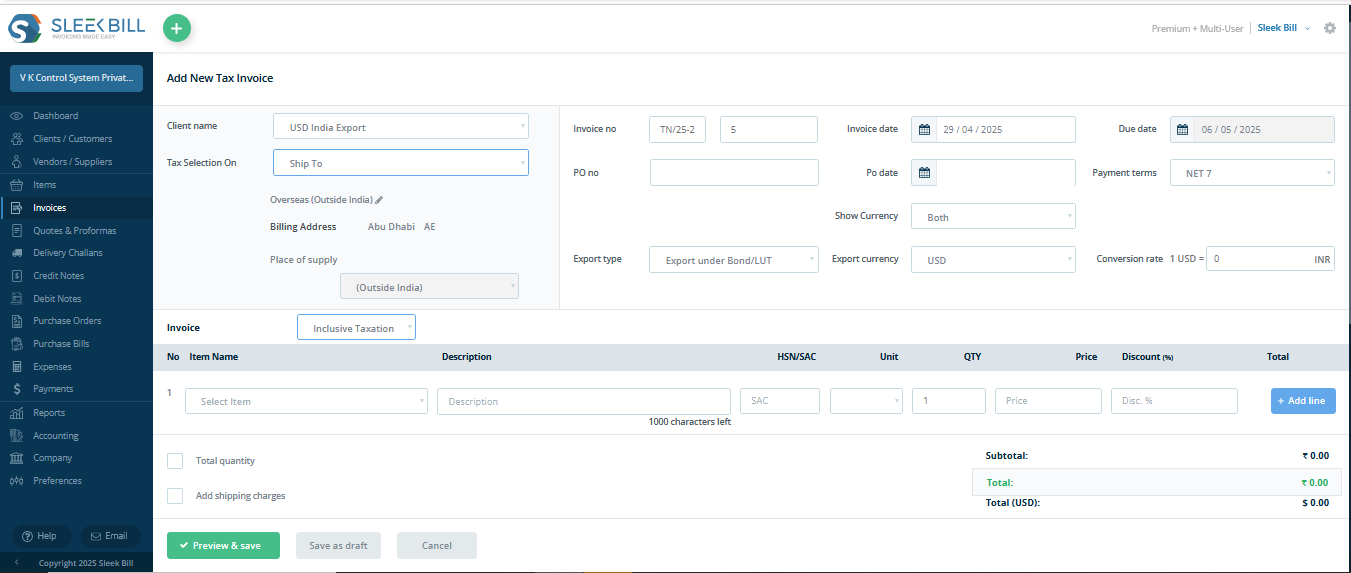
Select client name
Select "Tax Selection On" ship to or Bill To
Select place of supply
Enter PO number
Enter Invoice date, due date, payment term
Select currency: both
Select export currency as your client currency
Enter conversation rate of your and your client currency
Select invoice tax or exclusive item
Select item , quanity, price, discount if applicable
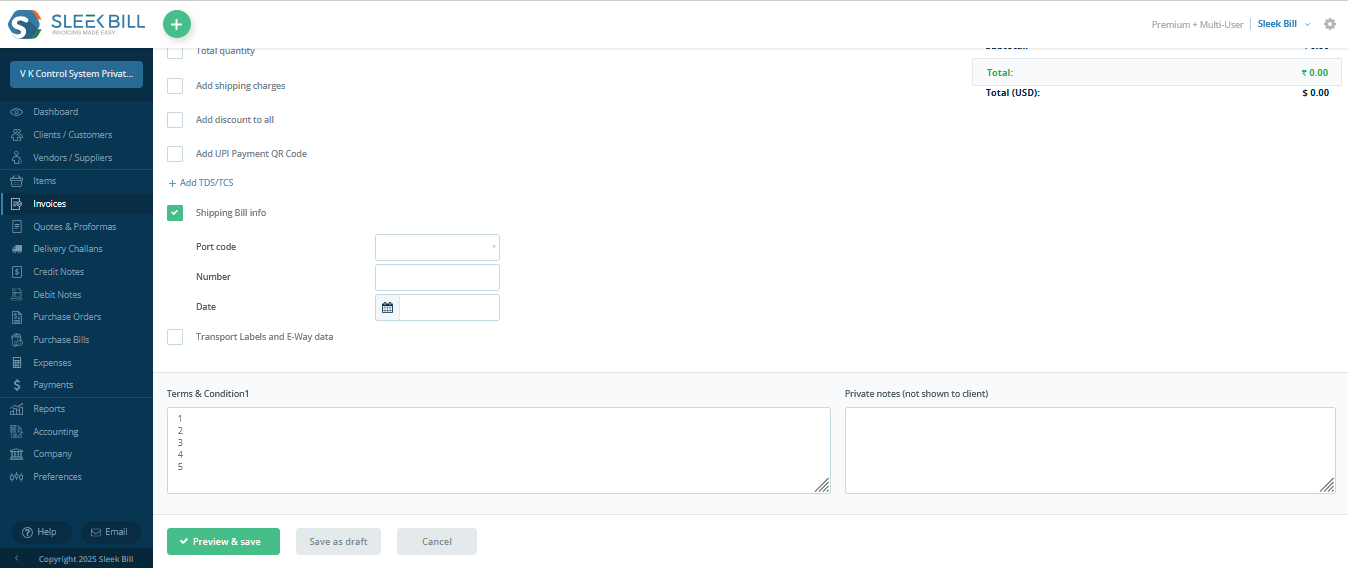
Add shipping charges(optional)
Enter Shipping Bll info
Enter term and condition and Save
| Advantages | Disadvantages |
|---|---|
| Extends market coverage beyond national boundaries and expanding the business. | Complex cross-border regulations and regulatory compliance. |
| Supports revenue diversification and growth potential across different countries. | Higher transportation cost and longer lead times. |
| Promotes competitiveness through global standards and exposure. | Barriers to overcoming cultural and linguistic barriers. |

Different business models exist within import-export trade:
1. Direct Exporting and Importing:
Businesses independently manage all import-export procedures.
2. Trading Companies:
Firms specializing in buying products domestically and selling abroad or vice versa.
3. Distributors:
Companies importing goods and distributing domestically, or exporting local goods internationally.
4. Export Management Companies (EMCs):
Companies handling export processes like market research and logistics on behalf of manufacturers.
5. Import-Export Agents:
Intermediaries facilitating trade deals between buyers and sellers, earning commissions.
6. Customs Brokers:
Experts handling customs clearance and ensuring compliance with regulations.
7. E-commerce Platforms:
Digital marketplaces facilitating cross-border transactions.
Profit is earned by buying products at low rates from foreign and selling at a high price locally, or vice versa. Successful negotiation for better price, good sourcing at low cost, and good logistics with effective cost management are essential in order to maximize the profit margins.
For Importing any goods:
Authorized Import licenses and permits
Customs entry forms
Commercial invoices of product
Airway bills or bills of lading.
Certificates of origin for quality inspections of product
For Exporting:
Authorized Export licenses and permits
Commercial invoices
Airway bills or bills of lading
Certificate of origin and quality compliance and assurance documents

Determine market segmentation, in-demand products, and lucrative niches.
Define your objectives, funding requirements, supply chain approach, and target market.
Get required import/export licenses, certifications, and registrations.
Build solid relationships locally or abroad.
Coordinate shipping arrangements, paperwork procedures, and warehouse facilities.
Be attuned to trade regulations, tariffs, and international standards.
Use software like Sleek Bill to manage international invoicing, currency exchange, and payment tracking in a smooth way that make business easy and reduce stress of managing payments.
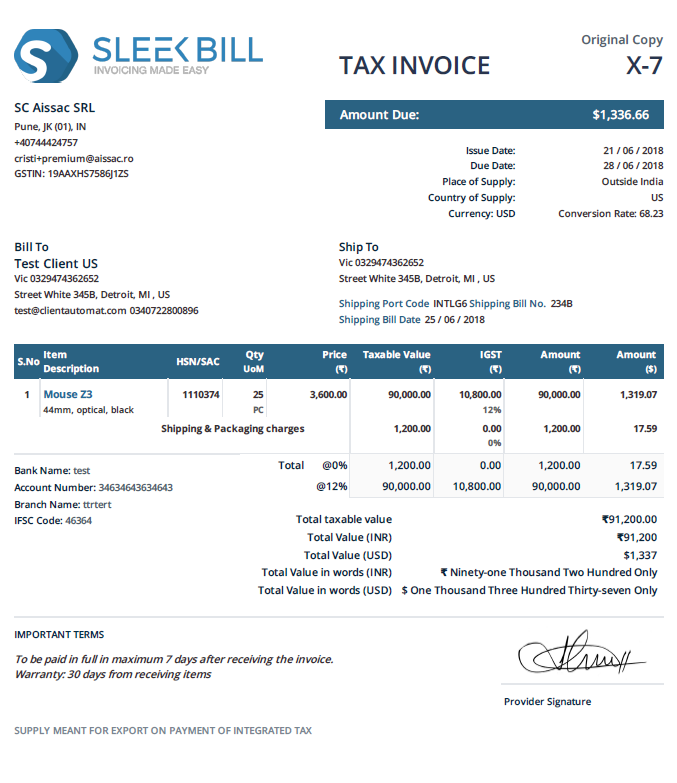
Sleek Bill simplifies international invoicing and compliance with regulations:
Export invoices professionally created with ease without any hassle.
Dynamic exchange rates.
Clear documentation of product information, price, and supply location.
Easy e-way bill and e-invoice generation, along with regulatory compliance.
Detailed financial reporting to monitor profits, expenses, and payments at a glance.
Knowing what an import-export business is and how to run a successful one can equate to profitable financial ventures abroad. With technology such as Sleek Bill, you can enjoy seamless operations, compliance, and profitability in the long run. Beginning your import-export business? Gear up with suitable tools and insight, and begin looking for worldwide business opportunity today
 GST Export Invoice Format
Requirements for export invoice templates in GST.
 Credit Note Format
Why Need Credit Note?

Requirements for composition scheme documents.

GST features in online billing software.
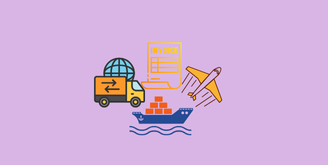
Requirements for export invoice templates in GST.
Receipt of items or services for GST Exempt.
केंद्रीय वस्तु एवं सेवा कर

Receipt voucher record the receipt of payment.


It involves buying goods from foreign markets (importing) and selling domestic products abroad (exporting).
Yes, with good planning and sourcing, and well-organized logistics management, import-export can be very profitable business.
It depends on market demand, product need of consumer, finance availability, personal experience and market insights. Typical options include machinery, electronics, clothing, and food.
Utilize online marketplaces, attend trade fairs, get engaged with trade associations, use government export promotion councils, and professionally network on LinkedIn.
 Free training & support
 60K Happy Customers Worldwide
 Serious about Security & Privacy
Use sleekBill and stay compliant with Generating GST Export invoice for different Currencies.
*Free & Easy - no hidden fees.
 Call Back Request