A Complete Guide for understand income tax return.
*Free & Easy - no hidden fees.
 Call For Demo 9168696091/92/93







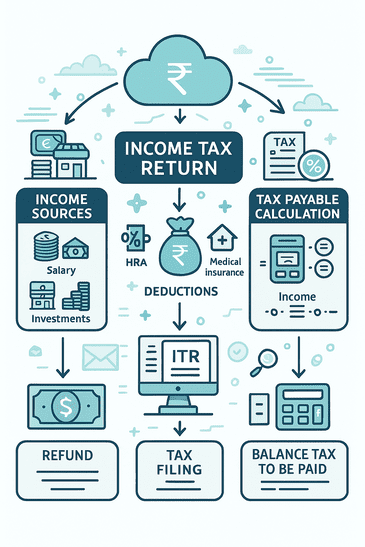
In order to report their yearly income, tax deductions, exemptions, and taxes paid, Indian taxpayers must file an Income Tax Return (ITR). According to the Income Tax Act of 1961, individuals and entities that meet certain income or transaction thresholds are required to file an ITR.
The act of electronically submitting your income tax return via the official portal of the Income Tax Department is known as "e-filing." For the majority of Indian taxpayers, this quick, safe, and practical method has taken the place of traditional paper filing.
Time and effort savings
Decreases the possibility of manual errors
Accessible from any location with internet connectivity
Real-time tracking of return and refund statuses
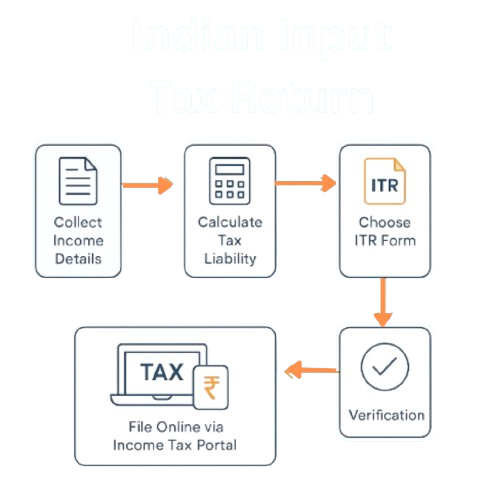
To accurately finish your efile process, adhere to these detailed instructions:
Step 1 – Go to Tax portal and log in using your PAN (user ID), password, and captcha code.
Step 2 – Begin the filing process Go to e-File → Income Tax Returns → File Income Tax Return.
Step 3 – Choose Assessment Year Select Assessment Year 2025–26 for FY 2024–25.
Step 4 – Select Filing Status Individual, Hindu Undivided Family, or Others are the options.
Step 5 – Choose the Type of ITR Form
Step 6 – Select the Filing Reason
Step 7 – Examine and Verify Data
Step 8 – E-Verify Your Return
30th November of the next financial year.
Date of filing the annual return.
Annual income exceeds ₹2.5 lakh (old tax regime) or ₹3 lakh (new tax regime).
Business receipts exceed ₹60 lakh
Professional receipts exceed ₹10 lakh
Deposits in current accounts exceed ₹1 crore.
Residents with foreign assets or authority in foreign bank accounts.
Prepare the following before beginning your efile
PAN and Aadhaar cards. bank interest certificates
Bank statements and account information
Form 16 (for salaried individuals)
Trading statements (for stock or mutual fund investments)
Receipts of insurance premium
A mobile number connected to Adhaar for OTP verification
Some purchases are not eligible for ITC:
Personal use items.
Food & beverages, catering, and club memberships.
Health insurance, except when required by law.
Construction expenses for immovable property.
Motor vehicles used for personal purposes.

Login: Enter your PAN and password to access the e-Filing portal
Select View Returns/Forms
Choose the appropriate assessment year and "Income Tax Returns."
An ITR filing list will show up
To download the ITR-V Acknowledgment Number, click on it.
Download your ITR or ITR-V in PDF format

Salary or pension
Capital gains from shares, mutual funds, or real estate
Rental income from house property
Other sources (interest, dividends, lottery, etc.)
Late Filing Penalty: ₹1,000 to ₹5,000 under Section 234F
Interest on Outstanding Tax: Section 234A/B/C imposes interest
Loss of Carry-Forward Benefits: Business and capital losses cannot be adjusted in future years
Legal Consequences: If tax evasion is proven, penalties and prosecution may follow
Legal Compliance & Avoiding Penalties
Easy Loan Approvals (Home, Car, Personal Loan, etc.)
Proof of Income & Financial Stability
Claiming Tax Refunds
The ability to electronically file your ITR has made India's tax system more transparent, digital, and user-friendly for taxpayers. Filing taxes has never been simpler thanks to government-backed portals and little paperwork. To remain compliant and stress-free, e-file your ITR before the deadline if you meet the filing requirements or even if you don't but still wish to receive financial benefits. Get started with e-filing right now; it's safe,
Sleek Bill provides free consulting for ITC claims, ensuring businesses can seamlessly manage their GST compliance and tax planning. Contact us today for expert assistance!

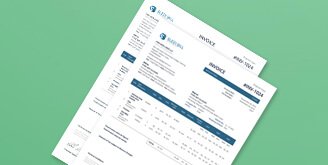 GST Invoice Format
Requirements for invoice templates in GST.
 GST Billing Benefits
Advantages & benefits of the new tax system.

Requirements for composition scheme documents.

GST features in online billing software.
 GST Credit Note
Find out when and how to issue GST compliant credit notes.
 GST Online Advantages
Benefits of online over offline invoice software.
Requirements for export invoice templates in GST.
Receipt of items or services for GST Exempt.
केंद्रीय वस्तु एवं सेवा कर

Receipt voucher record the receipt of payment.




Any individual whose income exceeds the exemption limit set by the government must file an ITR.
You can file your ITR through the official Income Tax e-filing portal:
PAN card Aadhaar card Form 16 (for salaried employees) Bank statements Investment details (PPF, FD, etc.) Property-related documents (if applicable)
Visit the Income Tax e-filing portal and check under "Refund Status" after logging in.
Yes, an ITR can be revised before 31st December of the same assessment year.
 Free training & support
 60K Happy Customers Worldwide
 Serious about Security & Privacy
Leverage Sleek Bill for Seamless Billing & Financial Management!
*Free & Easy - no hidden fees.
 Call Back Request