GST Journey A History, Timeline of Milestones, and Impact
The Goods and Services Tax (GST) in India is a landmark tax reform aimed inside the path of converting more than one indirect taxes with a unified tool. First proposed via the Kelkar Task Force in 2000, GST sought to simplify the tax form, cast off cascading taxes, and sell economic integration. After years of deliberation and amendments, GST modified into in the end done on July 1, 2017.
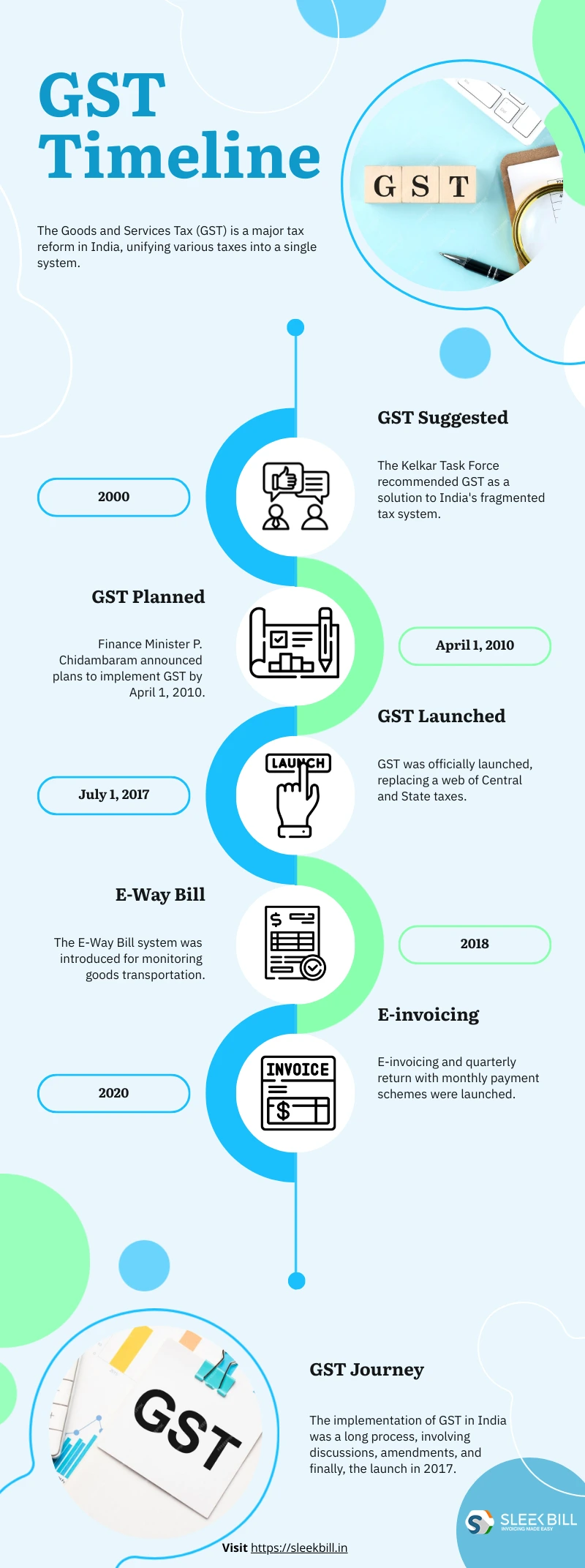
The Evolution of GST in India: Key Milestones
Early Developments (2000-2009)
2000: The Kelkar Task Force suggested GST as a approach to India's fragmented tax machine.
2006: Finance Minister P. Chidambaram announced plans to implement GST through the usage of April 1, 2010.
2009: The Empowered Committee of State Finance Ministers released the First Discussion Paper on GST.
Constitution Amendments & Deliberations (2010-2016)
2010: The authorities postponed GST implementation to April 2011.
2011: Introduction of the 115th Constitution Amendment Bill in Lok Sabha, later sent to the Standing Committee on Finance.
2013: The Standing Committee submitted its file, however the bill lapsed with the dissolution of Lok Sabha.
2014: The 122nd Constitution Amendment Bill became brought.
2015: The GST Bill modified into surpassed in Lok Sabha, and a Select Committee in Rajya Sabha reviewed it.
2016: The invoice become passed in every homes and became the only hundred and primary Constitution Amendment Act.
2017: The GST Council finalized CGST, SGST, IGST, and UTGST Bills.
July 1, 2017: GST was officially done, replacing an internet of Central and State taxes.
GST and Centre-State Financial Relations
GST marked a fundamental shift in India's financial landscape, unifying Central and State tax structures:
Dual GST Structure
CGST (Central GST) – Levied by the Central Government.
SGST (State GST) – Levied by State Governments.
IGST (Integrated GST) – Applicable on inter-state supplies.
Revenue Sharing
GST Council
A joint forum with representatives from all States and Union Territories.
Decides tax rates, exemptions, and revenue sharing mechanisms.
Compensation to States
Key Features of GST
Using a software tool, like Sleek Bill’s billing software, can streamline creating bills of exchange format and improve accuracy. Here’s how:
1. One Nation, One Tax: A single tax structure for the duration of India.
2.Dual GST Model: Central and State GST levied on intra-nation factors.
3.Destination-Based Tax : Taxes are paid inside the state in which objects/services are fed on.
4. Input Tax Credit (ITC) : Reduces tax burden by way of offsetting tax paid on inputs.
5.Threshold Exemption: Small agencies with a turnover beneath ₹40 lakh (items) or ₹20 lakh (services) are exempt.
6.Composition Scheme: Simplified tax compliance for small organizations.
7.Online Compliance: Digital GST submitting and automatic go back approaches.
8.Anti-Profiteering Measures : Prevents businesses from unduly increasing expenses under GST.
The Impact of GST -Changes and Challenges
GST marked a fundamental shift in India's financial landscape, unifying Central and State tax structures:
Focus on Supply & Destination-Based Taxation
Digital Compliance Tools
E-Way Bill System – Mandatory for inter-united states of america movement of products above ₹50,000.
E-Invoicing – Standardized invoicing to lower tax evasion.
GST Portal – Online gadget for tax submitting, refunds, and ITC claims.
Challenges Faced
Initial IT infrastructure issues triggered delays in compliance.
Frequent tax price modifications forced companies.
Delayed refunds impacted walking capital.
Future Prospects
Improved GST era infrastructure for seamless compliance.
Potential explanation of tax slabs to simplify tax fees.
Better cooperation among Centre and States to make sure easy implementation.
The GST journey is a testomony to India's willpower to tax reform and economic integration. Since its implementation in 2017, GST has converted India’s tax structure, advanced compliance, and reduced oblique tax complexities. With persisted coverage refinements, GST is expected to adapt similarly, making sure a greater efficient and business-pleasant tax gadget.
For professional GST registration and compliance session, Sleek Bill gives unfastened consulting to help corporations stay compliant and green in their tax control.
 Call For Demo 9168696091/92/93









 GST Invoice Format
 GST Billing Benefits


 GST Credit Note
 GST Online Advantages








 Free training & support
 60K Happy Customers Worldwide
 Serious about