
A Complete Guide for GST Compliance
*Free & Easy - no hidden fees.
 Call For Demo 9168696091/92/93
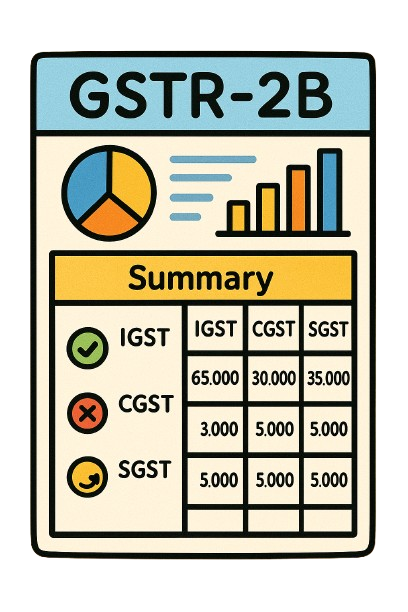







In the GST compliance space, reconciliation of Input Tax Credit (ITC) on time and with accuracy is crucial. For this purpose, the GST Network (GSTN) launched GSTR-2B, an auto-drafted statement of ITC, aimed at helping taxpayers achieve accurate ITC claims and GST compliance. This article explores the details of GSTR-2B, explaining its attributes.
GSTR-2B is a static auto-drafted statement produced on a monthly basis for each registered taxpayer. It aggregates the inward supplies details, such as invoices, debit notes, and credit notes, provided by suppliers in their respective returns like GSTR-1, GSTR-5, and GSTR-6. The main purpose of GSTR-2B is to give taxpayers a complete picture of their eligible and ineligible ITC for a particular tax period, thus enabling them to claim accurate ITC in their GSTR-3B returns.
GSTR-2B is generally generated on the 14th of the next month after the tax period. But this
if the due date for filing GSTR-1 is delayed, generation of GSTR-2B will also be delayed
date can change if there are delays in the due dates for filing supplier returns. For example,
accordingly to allow for the changes.

Information in GSTR-2B is gathered from the following sources:
GSTR-1: Information of outward supplies submitted by regular taxpayers.
GSTR-5: Returns submitted by non-resident taxable persons.
GSTR-6: Returns submitted by Input Service Distributors (ISD).
Invoice Furnishing Facility (IFF): Information furnished by taxpayers under the Quarterly Return Monthly Payment (QRMP) scheme.
ICEGATE: Details on IGST paid on inward supplies and imports from Special Economic Zones (SEZs) GST Tutorial.
The generation of GSTR-2B depends on the timely submission of supplier returns. The cut off date is usually the 13th of the following month, after which GSTR-2B is generated on the 14th. Any data filed after this cut-off will be picked up in the next month's GSTR-2B.
In cases where the paid IGST on imports is not accounted for in GSTR-2B, taxpayers must use the 'Search BoE' (Bill of Entry) option on the GST portal. The facility provides the recovery of missing documents from the ICEGATE system so that correct eligible ITC is reported .
GSTR-2B has two major segments:
Part A: Information of inward supplies from registered persons, ISD, imports, and supplies subject to reverse charge.
Part B: Details of credit notes and amendments involving ITC reversal.
Part A: Inward supplies in which ITC is ineligible due to reasons such as supplier non-compliance or time limit.
Part B: Credit notes and amendments involving ineligible ITC. Additionally, GSTR-2B provides section-wise advisories guiding taxpayers on the actions to be taken for each entry .
To view or download GSTR-2B :
Log in to the GST portal
Navigate to Services > Returns > Returns Dashboard.
Select the relevant financial year and return filing period.
Click on GSTR-2B to view or download the statement in PDF or Excel format GST Tutorial.
Error-Free ITC Claims: Gives a sure foundation for claiming valid ITC,reducing inaccuracies.
Improved Compliance: Supports compliance with GST law by making sure valid ITC is claimed.
Effective Reconciliation: Effective Reconciliation: Makes it easy to reconcile purchase records with supplier statements.
Risk Mitigation: Decreases chances of notices or penalties for improper ITC claims.

 GST Export Invoice Format
Requirements for export invoice templates in GST.
 Credit Note Format
Why Need Credit Note?

Requirements for composition scheme documents.

GST features in online billing software.

Requirements for export invoice templates in GST.

Receipt of items or services for GST Exempt.

केंद्रीय वस्तु एवं सेवा कर

Receipt voucher record the receipt of payment.




GSTR-2B is a combined statement of ITC that helps the taxpayers determine eligible and ineligible credits for a particular tax period, hence allowing true GSTR-3B submissions.
It is usually prepared on the 14th of the next month after the tax period, from the data provided by suppliers up to the 13th.
GSTR-2B is an auto-drafted statement and is not required to be filed. Taxpayers can use it as a reference to claim ITC in their GSTR-3B returns.
 Free training & support
 60K Happy Customers Worldwide
 Serious about Security & Privacy
Make Your First Invoice in Seconds!
*Free & Easy - no hidden fees.
 Call Back Request